


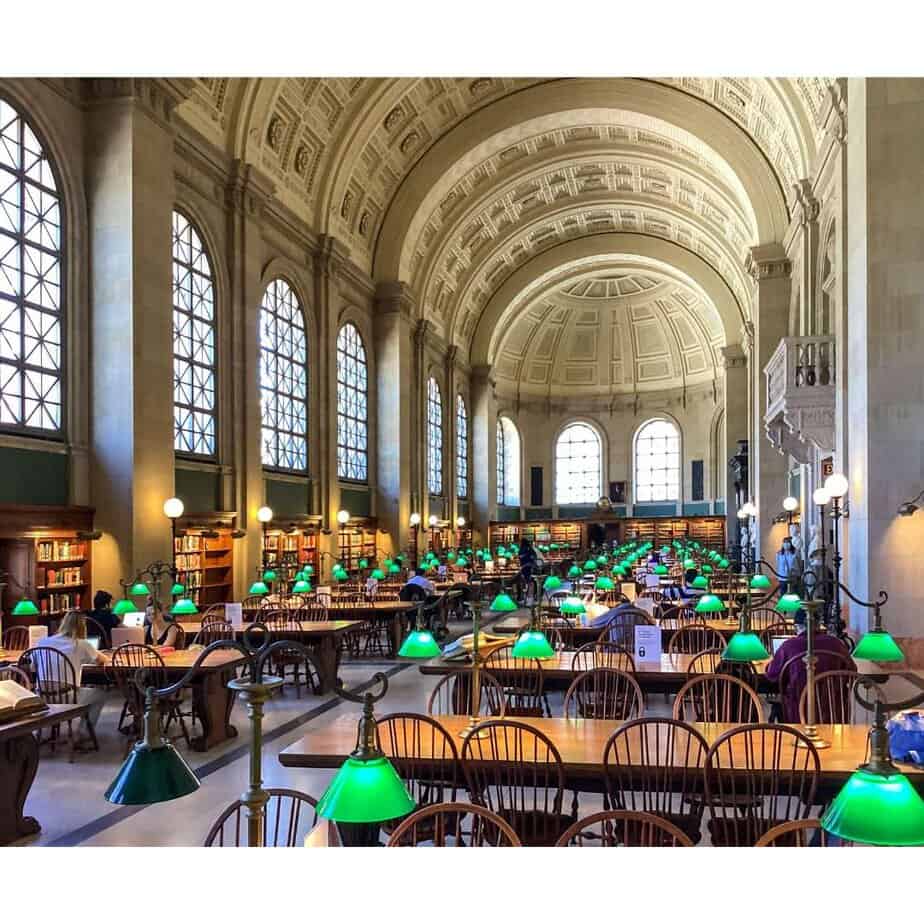
Few reading rooms in the United States rival the beauty and scale of Bates Hall inside the historic Boston Public Library – McKim Building in Boston. With its soaring vaulted ceiling, rows of green reading lamps, and long oak tables filled with students and researchers, the room has become one of the most iconic library interiors in America. Recently, Eustis Chair had the honor of helping preserve this historic space by producing 50 historically accurate replica Windsor chairs for Bates Hall. The project required careful research into the origins of the Windsor bow-back chairs traditionally used in the room, along with a deep appreciation for the architectural vision behind one of the nation’s most celebrated libraries.
 The Architectural Vision Behind the McKim Building
The McKim Building opened in 1895 and was designed by Charles Follen McKim of the firm McKim, Mead & White. Inspired by Italian Renaissance palaces, the building was conceived as a civic monument dedicated to learning, art, and public access to knowledge.
From the beginning, the Boston Public Library was intended to serve everyone. A transformative donation from Joshua Bates in 1852 helped establish the institution as a free public library, setting a powerful precedent for libraries across the United States. Learn more about the library’s history: https://www.bpl.org/bpl-history/

Bates Hall: One of America’s Great Reading Rooms
Stretching nearly the entire length of the building, Bates Hall measures approximately 218 feet long and features a dramatic barrel-vaulted ceiling that rises about 50 feet high. Large arched windows line both sides of the hall, flooding the space with natural light. Inside the room, rows of long oak reading tables are arranged beneath the iconic green lamps that have become synonymous with historic library interiors. The hall was designed to accommodate hundreds of readers at once, reinforcing the Boston Public Library’s mission of making knowledge accessible to the public. You can explore more photos of the space here: https://www.bpl.org/photos-of-bates-hall/
When the room opened in the late nineteenth century, it was furnished with Windsor-style armchairs, traditionally painted black, placed around the large reading tables. These chairs were chosen not only for their appearance but also for their durability and comfort during long hours of study.
The Origins of Windsor and Bow-Back Chairs
The seating used in Bates Hall draws from the long tradition of the Windsor chair, one of the most recognizable forms in furniture history.
Windsor chairs first appeared in England in the early eighteenth century before becoming widely adopted in colonial America. Their construction method made them both durable and efficient to produce. Rather than relying on complex panel joinery, Windsor chairs feature:
-A solid wood seat into which the legs and spindles are inserted
-Turned wooden legs and stretchers crafted on a lathe
-A curved back rail supporting slender vertical spindles
An overview of Windsor chair history can be found here: https://en.wikipedia.org/wiki/Windsor_chair
One of the most recognizable variations is the bow-back Windsor, where a continuous curved rail forms the top of the chair’s back. This elegant yet practical design provides strength while keeping the chair visually light. During the eighteenth and early nineteenth centuries, Boston was a major center for Windsor chair production, with local craftsmen producing large numbers of chairs distributed throughout New England. A deeper study of Windsor furniture making in Boston is available here:
https://www.colonialsociety.org/publications/3297/windsor-furniture-making-boston-late-innovative-center-craft
By the late nineteenth century, Windsor chairs were strongly associated with the Colonial Revival movement, which celebrated early American craftsmanship. Architects and designers often select Windsor seating for libraries, universities, and civic spaces to reinforce a sense of tradition and authenticity.
Recreating the Historic Chairs for Bates Hall
After more than a century of continuous use, maintaining the historic integrity of Bates Hall sometimes requires the careful reproduction of original furnishings.
Eustis Chair was commissioned to produce 50 Windsor chair replicas that match the historic style and proportions of the seating traditionally used in the room. Reproducing these chairs required detailed attention to the design elements that define Windsor construction—from the sculpted wooden seat to the curvature of the bow back and the turning of the legs.
Projects like this require balancing historical accuracy with modern durability, ensuring the chairs remain faithful to the original design while standing up to the daily demands of a public reading room.
Preserving an Icon of American Libraries
Today Bates Hall remains one of the most beloved spaces in the Boston Public Library. Visitors from around the world gather beneath its vaulted ceiling to read, work, and experience one of the great civic interiors in the United States. Additional information about the Boston Public Library’s historic buildings can be found here: https://www.bpl.org/locations/central/
Participating in the preservation of spaces like Bates Hall is both an honor and a reminder that thoughtfully crafted furniture plays a quiet but important role in historic architecture. When seating is built with care and respect for tradition, it becomes part of the story of the room itself—supporting generations of readers while maintaining the timeless character of the space.