



A Guide to Choosing Boarding School Seating
Boarding schools need seating for many different environments, from dining halls, classrooms, and libraries to chapels, auditoriums, common spaces, and multipurpose rooms. The best approach is not necessarily to use the same chair everywhere. Instead, choose chairs according to how each space functions, then create continuity across campus through hardwood, finishes, upholstery, and design details.
A boarding school is more than a collection of classrooms. It is where students eat, study, learn, gather, perform, worship, collaborate, and build community. Many of those activities happen in shared spaces that may remain in service for generations. That creates an unusual furniture challenge.
A dining hall chair needs to withstand frequent daily use and movement. A classroom chair needs to support students through lessons and discussions. A library chair may be occupied for hours at a time. A chapel may require orderly rows. A multipurpose room may need to transform from one event to another.
For schools, architects, and designers, the goal is to select seating that works for each individual space while still feeling appropriate to the institution as a whole.
Start With the Campus, Not the Chair
Before selecting a particular chair, identify where seating is needed and how each room functions.
Consider how many hours a day the space is used and how long students typically remain seated. Think about whether chairs will be moved frequently, whether the room needs to change configurations, and whether the chairs need to stack or form organized rows. Existing furniture matters as well. Chairs may need to work with current tables or coordinate with furniture elsewhere on campus. In historic or architecturally significant rooms, the design of the seating can also affect the character of the space.
Finally, consider how long the school expects to keep the chairs. Seating intended to remain in service for decades should be evaluated differently from furniture purchased for a short-term need. The answers may be very different from one building to another. That is why a campus-wide seating plan does not necessarily mean specifying one chair for the entire campus.
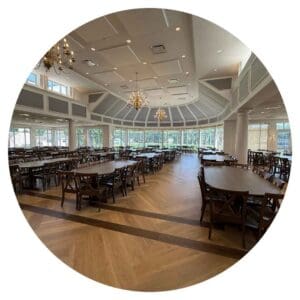 Dining Halls Need Chairs Built for Daily Use
Boarding school dining halls are among the hardest-working spaces on campus. Unlike a school where students leave at the end of the academic day, boarding school dining facilities may serve students for breakfast, lunch, dinner, special events, faculty meals, and other gatherings.
Chairs are constantly pulled from tables, repositioned, moved for cleaning, and used again. When selecting dining hall chairs, schools should consider construction and joinery, overall chair width, table dimensions, comfort, chair weight, stackability, finish durability, upholstery, and warranty coverage. Facilities requirements matter too, particularly when chairs need to be moved regularly for floor cleaning or room resets.
Chair dimensions deserve particular attention. A few inches of additional width can affect how many students fit comfortably around a table and how easily people circulate through the dining hall. The chair should therefore be evaluated as part of the entire dining-room layout, not as an isolated piece of furniture.
Stackability Can Make Dining Halls Easier to Manage
In many school dining halls, the ability to clear the floor is extremely valuable. Facilities teams may need to move chairs for cleaning, special events, room resets, or changes in table configuration. Stacking chairs can simplify those tasks.
However, schools should look beyond whether a chair simply stacks. They should understand how many chairs can be stacked safely, how much storage space a full stack requires, how heavy each chair is, and how the finished surfaces are protected during stacking.
It is also important to consider how frequently staff will move the chairs and where stacks will be stored when they are not in use. A true stacking chair should be designed for repeated stacking and unstacking rather than simply being capable of sitting on top of another chair.
 Classrooms Need Seating Designed Around How Students Learn
Classroom seating requirements can vary significantly across a boarding school. A traditional classroom may need chairs that are comfortable for a full class period, easy to move, and durable enough for years of daily student use. Seminar rooms and discussion-based classrooms may have very different needs.
Start by considering how instruction happens in the room. Students may primarily face the front of the classroom, frequently break into small groups, or move desks and tables to transition between lectures and collaborative work.
A classroom chair should support those activities rather than make them more difficult.
Seat height and proportions, comfort, chair weight, ease of movement, available floor space, table or desk dimensions, durability, and stackability can all influence how well a chair functions in the classroom.
For classrooms used throughout the day, construction becomes especially important. Even a chair that rarely leaves the room may be pulled, pushed, turned, and repositioned repeatedly by students.
Harkness and Discussion Rooms Require Careful Space Planning
Boarding schools that use Harkness or other discussion-based teaching methods have an additional consideration: the chair needs to work with the table and the conversation.
Students need to sit comfortably around a shared table while being able to see and interact with one another.
Chair dimensions can make a significant difference. A chair that is unnecessarily wide may crowd the table. One that is too deep may position students farther away from the discussion. Arms can affect both spacing and how closely the chair pulls toward the table.
Schools should consider the number of students who need to fit around the table, the dimensions of the table itself, the space occupied by each chair, and whether students can pull in and out easily. The chair should be comfortable for an entire class period while allowing students to turn naturally toward one another.
Whether arms are appropriate will depend in part on the table configuration.
Whenever possible, test a sample chair with the actual table.
 Libraries and Study Spaces Have Different Priorities
A library chair may remain occupied considerably longer than a dining hall or classroom chair.
Students may spend hours reading, studying, researching, writing, or working on laptops. Comfort and proportions therefore become particularly important.
Seat height, depth, back support, table height, and available workspace should all be considered together.
Durability still matters. Library chairs are pulled from tables and repositioned repeatedly throughout the day, particularly in busy academic libraries.
For historic boarding school libraries, the seating may also need to complement traditional architecture, millwork, reading tables, and other existing furniture.
A chair in this setting has both a functional and an architectural role.
Chapels Need Both Order and Flexibility
Many boarding schools have chapels or other ceremonial spaces that play an important role in campus life. Traditional pews create orderly rows and contribute to the architecture of the room, but they also limit how the space can be reconfigured.
Individual hardwood chairs can provide another option. Ganging systems can connect individual chairs to create straight, organized rows for chapel services, ceremonies, lectures, and other gatherings.
When the room needs a different configuration, the chairs can be separated. If the chairs also stack, the school may be able to remove seating entirely when the space is needed for another purpose.
This can provide the visual organization of traditional row seating without permanently fixing the room in one arrangement.
 Assembly and Performance Spaces May Need to Change Quickly
Boarding schools frequently use assembly spaces for more than one purpose.
A room might host an all-school meeting, lecture, performance, awards ceremony, parent event, or other gathering. That makes flexibility particularly valuable.
Stacking and ganging can work together in these spaces. Ganging creates organized rows when the room is set for an audience, while stackability makes it possible to remove some or all of the seating when another event requires open floor space.
For schools considering this approach, staff should evaluate how quickly chairs can be connected, separated, stacked, moved, and stored.
The people responsible for resetting the room should be part of the furniture-selection conversation.
Common Rooms and Student Gathering Spaces Need Flexibility
Boarding school life also happens in the spaces between classes, meals, and formal events.
Common rooms, student centers, house lounges, and other gathering spaces may host everything from casual conversations to meetings, activities, receptions, and special events.
Seating in these areas needs to respond to the way students actually use the space.
For chairs used around tables, comfort, table compatibility, and durability are important. When rooms are frequently rearranged, chair weight and mobility become more significant. Some gathering spaces may also benefit from stacking chairs that can be brought out for larger events and stored when more open space is needed.
These rooms may be less formal than a dining hall or chapel, but the furniture still contributes to the overall character of the campus.
 Traditional Campuses Do Not Require Old-Fashioned Functionality
Many boarding schools have a strong architectural identity. Historic dining halls, wood-paneled libraries, traditional classrooms, chapels, and distinctive campus buildings contribute to the character of the institution. New furniture should respect that character, but that does not mean sacrificing modern functionality.
Hardwood seating can provide a traditional appearance while incorporating stackability, ganging, reinforced joinery, custom dimensions, custom stains, upholstery, engraving, and other project-specific details.
The result can be a chair that looks appropriate to the campus while meeting the way the school operates today.
How Important Is Chair Construction in a Boarding School?
Very. Boarding school furniture experiences frequent use by generations of students. Chairs are pulled from tables, leaned on, moved, stacked, unstacked, and reset throughout the academic year. For hardwood seating, pay particular attention to the joints. Schools should understand how the joints are constructed, whether critical joints are reinforced, what the warranty covers, and whether the manufacturer has experience supplying chairs for comparable high-use educational environments.
Eustis Chair’s patented Eustis Joint® combines hardwood construction with concealed steel reinforcement and modern adhesive technology. Chairs featuring the Eustis Joint carry a 20-year warranty against joint failure.
For schools purchasing furniture with the expectation that it will remain on campus for many years, construction should be evaluated alongside initial purchase price.
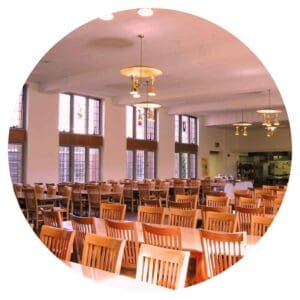 One Campus Does Not Need One Chair
Consistency is important, but consistency does not require identical furniture.
A boarding school dining hall and library serve different purposes. So do a classroom, chapel, and assembly space. Trying to force one chair to work everywhere can create compromises.
Instead, schools can establish a common design language through hardwood species, stain, upholstery, similar chair-back details, consistent proportions, and related design styles.
This allows each room to have seating appropriate to its function while maintaining a recognizable campus aesthetic.
Should a School Request Samples?
Yes, for a substantial seating project, samples are extremely useful. Do not evaluate the sample only by looking at it. Put it where it will actually be used.
Place a dining chair at the dining table. Test classroom seating with the desks or tables. Try a discussion chair around the Harkness table. Sit in a library chair for longer than a few minutes. Stack and unstack a stacking chair. Connect and disconnect ganging hardware.
When appropriate, schools can also ask students, faculty, facilities staff, designers, and other stakeholders for feedback.
A sample can identify practical issues before they are repeated across a large furniture order.
What Should a Boarding School Ask Before Buying Chairs?
Before specifying seating for a campus project, begin with what happens in the room every day. Consider how long students will typically remain seated and how frequently the chairs will be moved. Determine whether stacking is necessary, how many chairs can be stacked at once, and whether ganging is needed to create organized rows.
If chairs will be used with existing tables or desks, confirm that their dimensions work together. Schools should also understand how the chair joints are constructed, what the warranty covers, and whether hardwood, stain, and upholstery can be coordinated with existing furniture or architectural millwork.
Customization may be important for some projects, so determine whether the chair can be adapted to the school’s requirements and whether the school can provide its own upholstery if necessary.
Before making a substantial purchase, ask whether a sample can be tested in the actual space and whether the manufacturer has experience with comparable school installations. It is also worth considering the future: if additional chairs are needed years later, will matching seating still be available?
Choose Seating for the Way the Campus Works
The best boarding school seating plan recognizes that each space has its own job.
Dining halls need chairs prepared for constant daily use. Classrooms need seating appropriate to the way students learn. Libraries need chairs suited to longer study sessions. Harkness rooms need seating that works with both the table and the discussion. Chapels need orderly seating that respects the architecture. Assembly spaces need flexibility. Common rooms need furniture suited to the everyday life of the campus.
Those requirements can be different without making the campus feel disconnected.
Thoughtful use of hardwood, finish, upholstery, design, stacking, ganging, and customization can create continuity while allowing each space to function as it should.
Eustis Chair manufactures custom hardwood seating in the United States using domestic hardwoods. We have worked with boarding schools across the country to create seating for dining halls, libraries, classrooms, assembly spaces, chapels, and other campus environments.
Contact Eustis Chair to discuss hardwood seating for your boarding school project.