

At first glance, two hardwood chairs may look nearly identical. They may use the same wood species, have similar finishes, and even share a classic design. Yet one chair may begin to loosen, wobble, or fail after just a few years of daily use, while another remains solid for decades.
The difference often comes down to something most people never see: the joinery.
A chair is only as strong as the joints holding it together. Understanding how those joints are engineered can help explain why some hardwood chairs last a lifetime while others require constant repairs or early replacement.
Why Chair Joints Matter
Unlike a table, which primarily supports weight from above, a chair experiences stress from nearly every direction.
Chair joints absorb impact forces every time someone:
- Sits down
- Leans back
- Scoots across the floor
- Rocks on two legs
- Pushes away from the table
Over thousands of uses, these repeated stresses concentrate at the connections between the legs, seat rails, and back.
When those joints weaken, the chair begins to wobble. Once movement develops, it often becomes worse over time until repairs or replacement are necessary.
The Traditional Mortise and Tenon Joint
For thousands of years, wood furniture has relied on mortise and tenon joinery. In fact, this construction method dates back to ancient Egypt, where craftsmen used it to connect pieces of wood without metal fasteners.
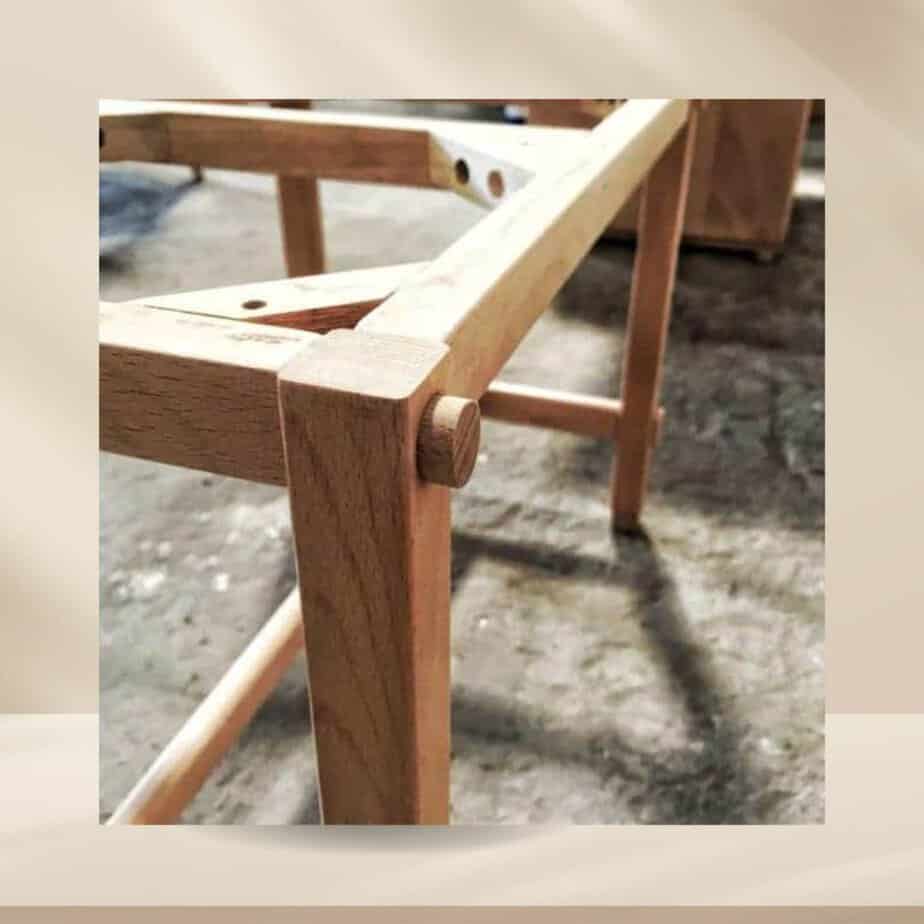
The technique has stood the test of time for good reason. A tenon, a shaped projection on one piece of wood, is inserted into a matching mortise, or cavity, in another piece. When combined with adhesives, it creates a strong mechanical connection.
Today, most hardwood chair manufacturers still build chairs using this same fundamental approach.
While mortise and tenon remains one of the strongest traditional woodworking methods, it still has a limitation: the joint itself is often the weakest point of the chair. Over years of heavy use, repeated stress can gradually loosen the connection, allowing movement that eventually leads to failure.
Engineering Has Changed. Chair Joinery Should Too.
Modern engineering has transformed nearly every industry.
Automobiles are safer.
Aircraft are stronger.
Building materials have evolved.
Yet many hardwood chair manufacturers continue to build chairs using essentially the same joinery principles developed thousands of years ago.
At Eustis Chair, we asked a different question:
What if the weakest part of the chair didn’t have to be weak at all?
Instead of accepting traditional limitations, we developed an entirely new approach to chair construction.
Introducing the Eustis Joint®
The Eustis Joint® is a proprietary joinery system engineered specifically to eliminate the traditional weaknesses found in conventional hardwood chair construction.
Rather than relying solely on traditional woodworking methods, the Eustis Joint® combines precision engineering with modern materials and manufacturing techniques to create chair joints that are exceptionally strong and designed to resist the loosening that often occurs with conventional construction.
The result is a hardwood chair that is engineered for decades of demanding use.
Every Eustis Joint® chair is backed by a 20-year warranty against joint failure, one of the strongest warranties available for hardwood seating.
Unlike traditional wood chairs that may eventually require tightening, regluing, or structural repairs, Eustis Joint® chairs are designed to remain solid throughout years of daily use without requiring joint maintenance.
Stronger Joinery Creates Better Design Opportunities
Improved engineering doesn’t just increase durability, it also expands what’s possible in chair design.
Because of the strength of the Eustis Joint®, many Eustis Chair models can stack up to 10 chairs high without sacrificing the beauty and warmth of solid hardwood construction.
Historically, stacking capability often meant choosing metal or plastic seating. Today, designers and facility managers can specify elegant hardwood chairs that offer both exceptional durability and efficient storage.
This makes them ideal for spaces that frequently reconfigure seating, including:
- Country clubs
- Universities
- Libraries
- Restaurants
- Private event spaces
- Churches
- Schools
- Dining halls
A Chair Is an Investment, Not an Expense
The true cost of a chair isn’t determined by its purchase price alone.
It’s determined by how long it remains in service.
A chair that needs replacement every few years often becomes far more expensive than one that lasts for decades.
Eustis Chair designs its hardwood chairs with an expected 20+ year useful life. When properly cared for, many can be refinished and reupholstered multiple times, extending their service life even further.
For organizations furnishing dining rooms, libraries, meeting spaces, and hospitality environments, investing in furniture built to last can save tens of thousands of dollars in future replacement costs while reducing waste.
Built Sustainably in the USA
Every Eustis Chair is manufactured to order in Western New York using sustainably sourced hardwoods.
Each chair can be customized with your choice of:
- Hardwood species
- Stain color
- Finish
- Upholstery
- Seat height
- Arm configuration
- COM (Customer’s Own Material)
- COL (Customer’s Own Leather)
Because the chairs are designed for decades of service and can be refinished instead of discarded, they represent a more sustainable alternative to furniture that must be replaced repeatedly.
Trusted by Organizations That Expect More
Eustis Chair is proud to manufacture seating for organizations that expect exceptional durability and timeless design.
Our chairs can be found in:
- Country clubs
- Yacht clubs
- Universities
- Public libraries
- Schools
- Churches
- Municipal buildings
- Restaurants
- Cultural institutions
Frequently Asked Questions
What is mortise and tenon joinery?
Mortise and tenon is a traditional woodworking method that has been used for thousands of years. It connects two pieces of wood by fitting a projecting tenon into a matching mortise. It remains one of the most common methods used to build hardwood furniture today.
Why do chair joints fail?
Chair joints experience constant twisting and impact forces every time someone sits, leans, or moves the chair. Over years of repeated use, these stresses can loosen traditional joints, leading to wobbling and eventual failure.
What makes the Eustis Joint® different?
The Eustis Joint® is Eustis Chair’s proprietary joinery system, engineered to overcome the limitations of traditional chair construction. It creates exceptionally strong joints that are backed by a 20-year warranty against joint failure and are designed to never require tightening or service.
Can hardwood chairs really stack?
Yes. Thanks to the strength of the Eustis Joint®, many Eustis Chair models stack up to 10 chairs high while maintaining the elegance and warmth of solid hardwood construction.
How long should a high-quality hardwood chair last?
A well-built hardwood chair should remain in service for decades. Eustis Chair designs its seating with a 20+ year useful life, and many chairs can be refinished and reupholstered multiple times to extend their lifespan even further.
Experience the Difference Better Joinery Makes
For thousands of years, chair construction changed very little. Traditional mortise and tenon joinery served generations of furniture makers well, but modern engineering has made it possible to build something even stronger.
At Eustis Chair, we believe the weakest part of a chair shouldn’t determine its lifespan. That’s why we developed the proprietary Eustis Joint®—a breakthrough in hardwood chair engineering that delivers exceptional strength, allows many models to stack up to 10 chairs high, and is backed by an unmatched 20-year warranty against joint failure.
If you’re furnishing a country club, university, library, restaurant, church, or other public space, invest in chairs built for generations—not just years.