


For more than three centuries, furniture makers have relied on a timeless vocabulary of design elements that continue to define elegant interiors today. Cabriole legs, pierced splats, ball and claw feet, tapered legs, and fluted detailing first appeared in the finest English furniture of the eighteenth century and remain popular in country clubs, private clubs, universities, libraries, hotels, and other distinguished spaces.
While the terms Queen Anne and Chippendale are often used interchangeably, they represent two distinct periods in the evolution of English furniture design. Understanding the differences between these styles not only provides historical context but also helps architects, interior designers, and facility managers select furnishings that complement traditional interiors.
At Eustis Chair, these classic design influences are thoughtfully reinterpreted into handcrafted commercial seating that combines timeless aesthetics with modern engineering and long-term durability.
The Evolution of Traditional Furniture Styles
Furniture styles rarely change overnight. Instead, they evolve gradually as designers build upon the work of previous generations.
The Queen Anne style emerged during the early eighteenth century, introducing graceful curves, restrained ornamentation, and elegant proportions that contrasted with the heavier Baroque furniture of the late seventeenth century.
As the Georgian period progressed, furniture makers embraced greater architectural symmetry and classical influences. One of the most influential designers of the era was Thomas Chippendale, whose 1754 publication, The Gentleman and Cabinet-Maker’s Director, helped popularize richly detailed furniture designs throughout Britain and the American colonies. Rather than inventing an entirely new style, Chippendale combined Gothic, Rococo, Chinese, and classical influences into designs that cabinetmakers adapted for generations.
Timeline of Traditional Furniture Styles
1702────────────1714────────────1754────────────────────1800

Queen Anne       Georgian          Chippendale

Curves           Symmetry          Decorative carving
Cabriole legs    Tapered legs      Pierced splats
Pad feet         Classical lines   Ball & claw feet
Queen Anne Furniture
The Queen Anne style is celebrated for its balance, elegance, and simplicity. Rather than relying on elaborate carving, furniture makers emphasized graceful silhouettes and refined craftsmanship.
 Common characteristics include:
- Cabriole legs
- Curved chair backs
- Vase-shaped splats
- Pad or Dutch feet
- Fine hardwood construction
- Soft flowing lines
- Restrained ornamentation
Although originally crafted for eighteenth-century homes, these characteristics continue to influence traditional furniture today.
What Is a Cabriole Leg?
The cabriole leg is one of the most recognizable features of Queen Anne furniture.
Named after the French word cabrioler, meaning “to leap like a goat,” the leg features two continuous curves. The upper portion curves outward before sweeping inward toward the foot, creating the graceful S-shaped profile that has become synonymous with traditional furniture design.
Although similar curved forms appeared in earlier Chinese and European furniture traditions, the cabriole leg became a defining characteristic of Queen Anne furniture and later appeared on selected Chippendale pieces as well.
Why do Designers Choose Cabriole Legs?
The flowing profile of a cabriole leg introduces movement and softness that complements traditional architecture. Its elegant proportions have made it a lasting favorite in:
- Country clubs
- Private clubs
- Historic hotels
- Ballrooms
- Libraries
- Universities
- Fine dining spaces

Georgian and Chippendale Furniture
The Georgian period encompasses several influential furniture movements, including Queen Anne, Chippendale, Hepplewhite, and Sheraton.
Among these, Thomas Chippendale’s work became especially influential after the publication of The Gentleman and Cabinet-Maker’s Director. Cabinetmakers across Britain and North America adapted his published designs, many of which incorporated elaborate carving and architectural motifs.
Compared with Queen Anne furniture, Chippendale pieces often feature:
- Decorative pierced splats
- Ball and claw feet
- Straight or tapered legs
- Fluted front legs
- Carved knees
- Architectural crest rails
- Gothic and Chinese decorative influences
Queen Anne vs. Chippendale
| Queen Anne | Chippendale |
|---|---|
| Cabriole legs | Straight, tapered, or cabriole legs |
| Minimal carving | More decorative carving |
| Simple splats | Decorative pierced splats |
| Pad or Dutch feet | Ball and claw feet |
| Softer silhouettes | More architectural appearance |
Understanding Chair Splats
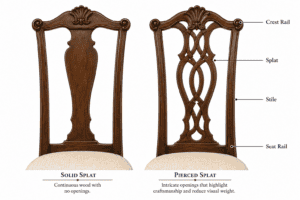
A splat is the decorative vertical support located between the crest rail and the seat of a chair. While it contributes to the chair’s structure, it also serves as one of its defining visual features.
Solid Splats
Solid splats are carved from a continuous piece of wood without decorative openings.
They create a more restrained appearance while emphasizing the natural beauty of the hardwood.
Examples within the Eustis Chair collection include:
- King and Prince
- University Club
Pierced Splats
A pierced splat contains decorative openings that create negative space within the chair back.
These intricate openings require precise layout and careful carving, making pierced splats one of the most technically demanding decorative elements in traditional chairmaking.
Beyond showcasing craftsmanship, pierced splats also create a lighter visual appearance by allowing light to pass through the chair back.
Examples within the Eustis Chair collection include:
- Claremont
- River Oaks
Tapered and Fluted Legs
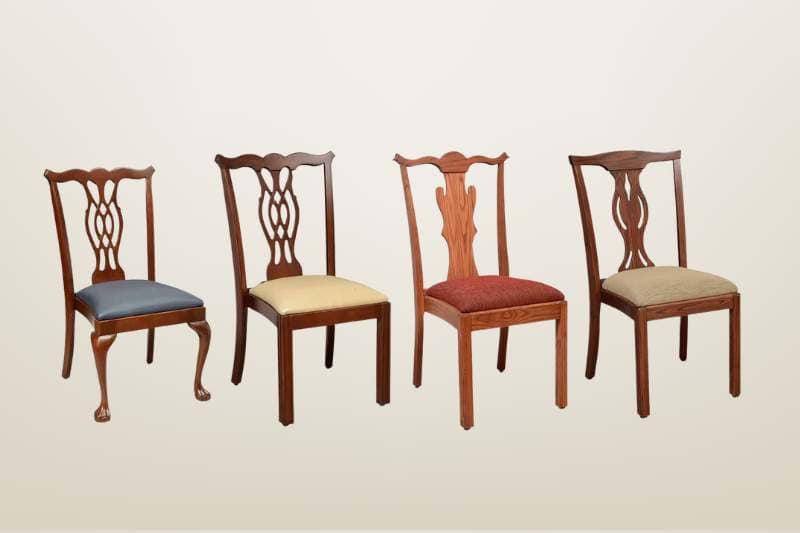
Not every traditional chair uses cabriole legs. As furniture styles evolved throughout the Georgian period, many cabinetmakers favored straight tapered legs for their refined architectural appearance. A tapered leg gradually narrows toward the floor, creating a lighter visual profile while maintaining excellent structural integrity. Many tapered legs also incorporate fluting, shallow vertical grooves inspired by classical Greek and Roman columns.
Traditional Furniture Feet
Furniture feet often provide clues about a chair’s historical inspiration.
Pad Foot
A rounded, understated foot commonly associated with Queen Anne furniture.
Dutch Foot
A slightly flattened variation of the pad foot that became popular during the same period.
Ball and Claw Foot
Widely believed to have been inspired by Chinese decorative motifs, the ball and claw foot became one of the defining characteristics of English Chippendale furniture and remains a hallmark of traditional craftsmanship.
 Historic Design Meets Modern Commercial Seating
Eustis Chair draws inspiration from these classic furniture traditions while engineering each chair for today’s demanding commercial environments.
Rather than reproducing antique furniture, our designs preserve timeless details while incorporating stackability, sustainable American manufacturing, and the proprietary Eustis Joint®, backed by a 20-year warranty against joint failure.
Ivy League Chair
The Ivy League Chair blends traditional English Chippendale influences with refined Georgian design aesthetics. Its distinctive back splat creates a sophisticated interpretation of eighteenth-century craftsmanship while remaining ideally suited for libraries, universities, and private clubs.
King and Prince
Our first Chippendale-inspired stacking chair features:
- Solid back splat
- Decorative ears at the crest rail
- Traditional proportions
- Stackable hardwood construction
University Club
Building upon the King and Prince, the University Club introduces a gracefully curved crest rail while maintaining its solid splat for a refined yet understated appearance.
Claremont
The Claremont elevates the Chippendale tradition through:
- Decorative pierced splat
- Fluted front legs
- Enhanced carving
- Greater visual refinement
River Oaks
The River Oaks combines several celebrated eighteenth-century design elements, including:
- Decorative pierced Chippendale splat
- Queen Anne cabriole front legs
- Ball and claw feet
- Commercial stackability
Ballroom
Designed in collaboration with Kemble Interiors for a prestigious private club in Manhattan, the Ballroom Chair embraces Queen Anne styling through elegant cabriole front legs and a graceful tulip-shaped back while providing the flexibility of stackable commercial seating.
Why These Designs Continue to Endure
Furniture styles have evolved over centuries, yet the finest examples continue to share the same defining characteristics: graceful proportions, exceptional craftsmanship, and thoughtful attention to detail.
Whether expressed through a cabriole leg, a decorative pierced splat, or a fluted tapered leg, these enduring design elements continue to inspire furniture makers around the world.
At Eustis Chair, we honor these traditions by crafting sustainable hardwood seating that preserves the elegance of historic furniture while meeting the performance demands of today’s commercial interiors.
Further Reading & Historical References
The historical information presented in this article is based on research from respected museum collections and primary furniture history resources, including:
- The Gentleman and Cabinet-Maker’s Director by Thomas Chippendale (1754)
- The Metropolitan Museum of Art – European Furniture Collection
- The Victoria and Albert Museum – British Furniture Collections
- Winterthur Museum, Garden & Library – American Decorative Arts
- Smithsonian Institution – Decorative Arts and Furniture Collections